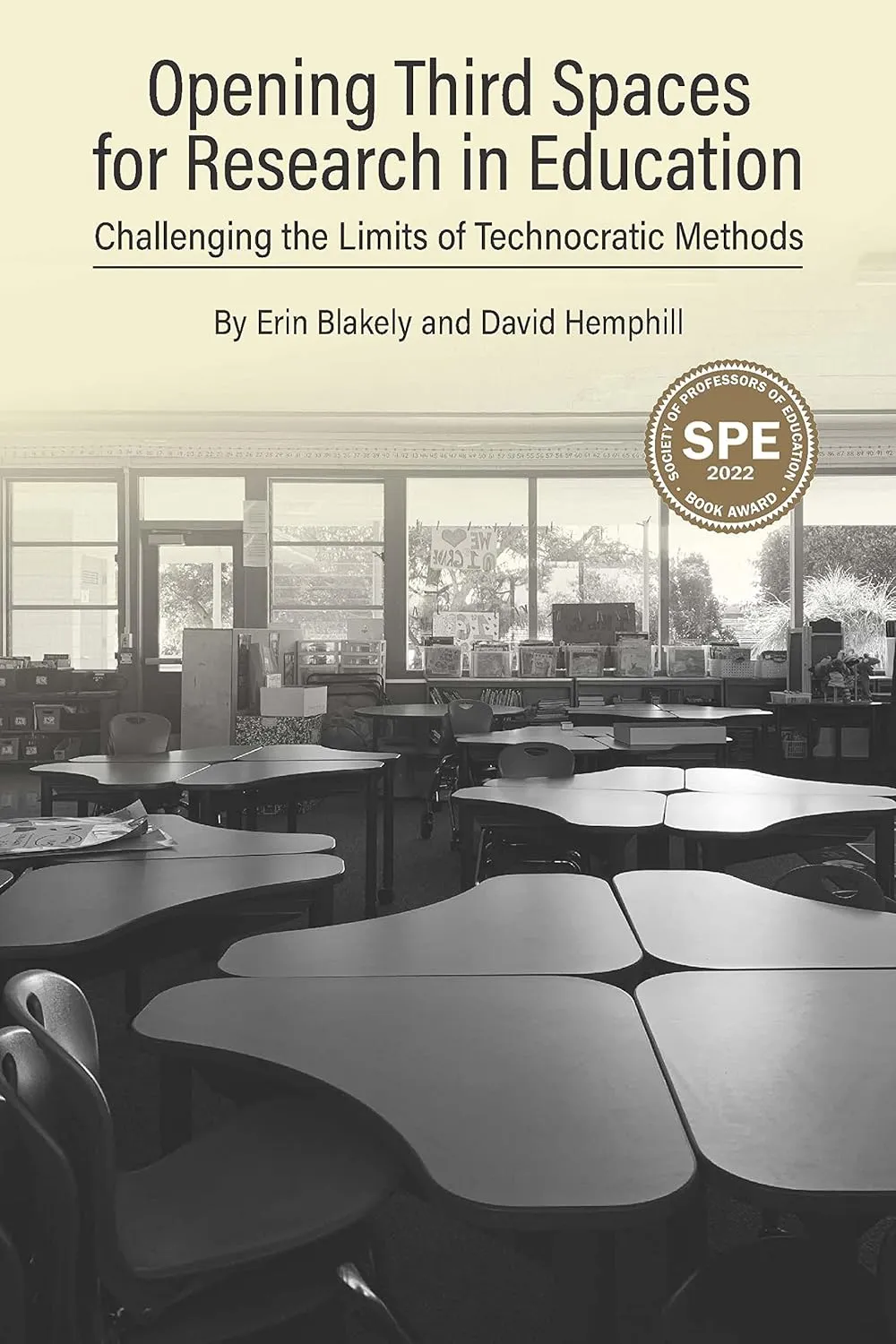
Opening Third Spaces for Research in Education
Challenging the Limits of Technocratic Methods
A 2022 Society of Professors of Education (SPE) Outstanding Book Award Winner
“Extremely well written and richly rewarding. Opening Third Spaces for Research in Education: Challenging the Limits of Technocratic Methods is a remarkable work. It contains a brilliant analysis of the problems haunting education today and it develops new ways of thinking and acting when it comes to educational research. A must read for anyone seriously interested in educational research today.”—Klaus Nielsen, Professor, Department of Psychology, Aarhus University, Denmark
“Blakely and Hemphill have written a methods book that our field desperately needs … It is essential reading for those aiming to develop research practices that disrupt the radicalized inequities in our field.” —Jeff Duncan-Andrade, Professor, Latina/o Studies & Race and Resistance Studies, San Francisco State University
“A highly recommended read for everyone planning to do research in education.”—Jacob Klitmøller, Associate Professor of Educational Psychology, Department of Psychology, Aarhus University, Denmark
“The book is joyfully well researched, crisply written, and brings together topics I often address in my teaching, yet never before with the support of a single text.” —Barbara A. Henderson, Director, Doctoral Program in Educational Leadership Graduate College of Education, San Francisco State University
“The brilliance of Opening Third Spaces for Research in Education: Challenging the Limits of Technocratic Methods lies in its being situated in colonial historicity … Given the unacceptable high rate of educational failure, particularly in urban areas populated mostly by non-white students, readers of this important book will understand that the predominance of the technocratic paradigm in educational research is an ideological trap that sacrifices human factors along the lines of gender, ethnicity, class, and culture at the altar of research objectivity. This insightful book must be read by all educators who consider themselves agents of change in the struggle to promote a less dystopian and more humane world.”—Donaldo Macedo, Ph.D., Professor Emeritus and Distinguished Professor of Liberal Arts, University of Massachusetts Boston